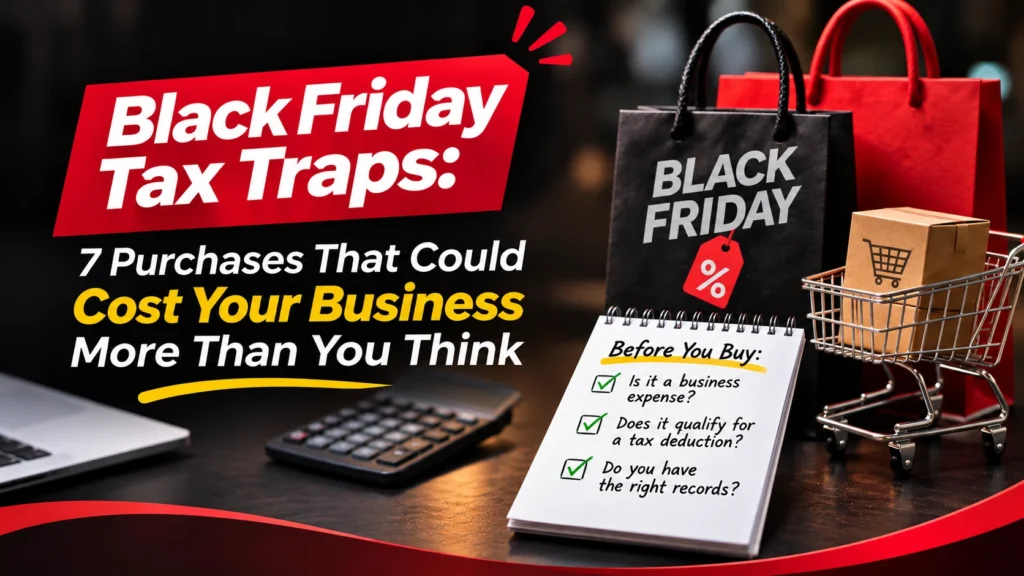
Black Friday is one of the biggest shopping events of the year. Businesses take advantage of major discounts to upgrade equipment, purchase supplies, and prepare for the holiday season.
However, not every Black Friday purchase is a tax deduction.
Many business owners assume that buying something for their company automatically makes it tax-deductible. Unfortunately, that is not how the IRS works.
Understanding Black Friday tax traps can help you avoid costly mistakes, organize your business expenses, and make smarter purchasing decisions before the end of the year.
In this guide, we explore seven common purchases that could create unexpected tax complications for your business.

1. Personal Electronics Disguised as Business Expenses
A new laptop, smartphone, or tablet might look like a great Black Friday deal. But can you deduct it from your business taxes?
The answer depends on how you use it.
The IRS generally requires business expenses to be both ordinary and necessary for your trade or business. An ordinary expense is common and accepted in your industry. A necessary expense is helpful and appropriate for your business.
For example:
- A laptop used exclusively for business operations may qualify as a business expense.
- A smartphone used for both personal and business purposes may require an allocation between the two.
- A gaming console purchased primarily for personal entertainment generally does not qualify as a business deduction.
The tax trap: Buying an expensive electronic device during Black Friday does not automatically make it deductible.
Keep your receipts and document the business purpose of each purchase.
2. Office Furniture You Don't Actually Need

Black Friday promotions often include attractive discounts on office chairs, desks, filing cabinets, and other furniture.
Although these items may qualify as business expenses, purchasing unnecessary equipment simply because it is on sale can hurt your cash flow. Before buying, consider:
- Does your business genuinely need the furniture?
- Will it be used for business activities?
- Is it replacing existing equipment or expanding your operations?
- How should the purchase be classified for tax purposes?
Depending on the item’s cost, business use, and applicable tax rules, furniture may need to be depreciated rather than deducted entirely in the year of purchase.
The tax trap: Spending $1,000 to save $200 is not necessarily a smart financial decision. A tax deduction generally reduces taxable income. It does not reimburse the entire purchase price.
3. Expensive Computers and Equipment
Technology upgrades are common during Black Friday. Businesses often purchase computers, monitors, printers, servers, and other equipment at discounted prices.
Some qualifying purchases may be eligible for accelerated deductions under provisions such as Section 179 or bonus depreciation.
However, these tax benefits have specific requirements. Before claiming a deduction, consider:
- Whether the equipment qualifies under the applicable tax rules.
- Whether it is used predominantly for business.
- When it was purchased and placed in service.
- Whether Section 179 or bonus depreciation applies.
- Whether other limitations affect the deduction.
The rules can change between tax years, so business owners should verify the applicable provisions before making major purchases.
The tax trap: Purchasing equipment before December 31 does not automatically guarantee a full deduction. The equipment generally must be placed in service during the applicable tax year, and additional eligibility rules may apply.

4. Holiday Gifts and Personal Purchases
Black Friday is also an opportunity to purchase gifts for employees, customers, and business partners.
However, not every gift receives the same tax treatment.
The IRS generally limits the business deduction for gifts to $25 per recipient per year, subject to specific exceptions and rules.
Employee gifts may also fall under fringe benefit rules. Certain low-value, infrequent benefits may qualify as de minimis fringe benefits, while cash and cash-equivalent gifts are generally treated differently.
Examples include:
- Holiday gifts for customers.
- Employee appreciation gifts.
- Promotional merchandise.
- Gift cards and prepaid cards.
- Personal gifts purchased using a business credit card.
The tax trap: Putting a personal gift on your business credit card does not automatically turn it into a deductible business expense. Keep records showing who received the gift, its business purpose, and its cost.
5. Clothing and Accessories Bought During Black Friday
Black Friday discounts make clothing and accessories particularly tempting purchases.
Some business owners may assume that suits, shoes, watches, and other clothing items qualify as business expenses because they wear them while working.
However, the IRS generally does not allow deductions for ordinary clothing suitable for everyday wear, even when the clothing is worn exclusively for work.
There are exceptions for qualifying uniforms and protective clothing that are not suitable for ordinary everyday use.
For example:
- Specialized protective equipment may qualify.
- Required uniforms that are unsuitable for everyday wear may qualify.
- Ordinary business suits generally do not qualify.
- Everyday shoes and accessories are generally personal expenses.
The tax trap: Wearing something to work does not automatically make it tax-deductible. Always distinguish between personal clothing and qualifying work-related protective or uniform expenses.
6. Subscriptions and Software You Never Use
Software companies frequently offer Black Friday discounts on annual subscriptions, accounting platforms, marketing tools, cloud storage, and productivity applications.
These purchases may qualify as business expenses when they are genuinely used for business purposes.
However, buying multiple subscriptions simply because they are discounted can create unnecessary costs.
Before purchasing, ask yourself:
- Does the software solve a real business problem?
- Does your company already have a similar subscription?
- Will employees actually use it?
- Is the subscription for business or personal use?
- Are there automatic renewal charges?
The tax trap: A discounted subscription is still an expense. Even when an expense qualifies for a tax deduction, your business must still pay the remaining cost. Keep invoices and subscription records to support legitimate business expenses.

7. Inventory Purchased Without a Clear Sales Strategy
For retailers and online sellers, Black Friday is an excellent opportunity to stock up on inventory.
Buying products at discounted prices can improve profit margins. However, purchasing too much inventory without a realistic sales strategy can create financial problems.
Inventory generally has different tax treatment from ordinary operating expenses.
For businesses using inventory accounting, the cost of goods sold (COGS) is generally calculated using beginning inventory, purchases and other applicable costs, minus ending inventory.
This means that buying inventory does not necessarily create an immediate tax deduction for the entire purchase amount.
Business owners should monitor:
- Beginning and ending inventory.
- Purchase invoices.
- Shipping and other inventory costs.
- Products sold during the tax year.
- Unsold inventory at year-end.
The tax trap: Buying more inventory does not automatically mean a larger tax deduction. Proper inventory records help businesses understand their actual costs, profitability, and tax obligations.
How to Avoid Black Friday Tax Traps
Smart purchasing decisions can help protect your business finances.
Before taking advantage of holiday discounts, follow these practical steps:
- Set a purchasing budget. Decide how much your business can afford to spend before browsing Black Friday promotions.
- Identify legitimate business needs. Focus on purchases that support your company’s operations.
- Keep every receipt. Maintain invoices, payment confirmations, and supporting documentation.
- Separate personal and business expenses. Avoid mixing personal shopping with company purchases.
- Document business use. Record how equipment, technology, and other assets support your business.
- Review depreciation rules. Understand whether qualifying purchases may be depreciated or eligible for accelerated deductions.
- Consult a tax professional. Review major purchases before the end of the tax year.
These steps can help you make informed decisions while reducing the risk of incorrect deductions and unexpected tax issues.
Final Thoughts: Don’t Let Black Friday Become a Tax Trap
Black Friday can be a great opportunity to invest in your business, upgrade equipment, and prepare for the year ahead. However, a discount does not automatically make a purchase tax-deductible.
Understanding IRS business expense rules, maintaining accurate financial records, and planning purchases carefully can help you avoid costly mistakes. Whether you operate an LLC, an S Corporation, or another type of business entity, professional tax guidance can make a difference when managing your finances.
At United Tax Solutions, we help business owners navigate tax preparation, accounting, bookkeeping, and other financial responsibilities. Don’t let a shopping deal turn into an unexpected tax problem.
Get in Touch Today!
Visit United Tax Solutions to learn how we can help you make informed financial decisions and prepare your business for tax season.